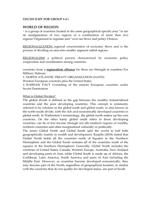

GEC103(LMTFORGROUP1-4)WORLDOFREGION~isagroupofcountrieslocatedinthesamegeographicalspecificareaorareanamalgamationoftworegionsoracombinationofmorethentworegionsOrganizedtoregulateandoverseeflowsandpolicyChoices.REGIONALIZATIONregionalconcentrationofeconomicflowsandistheprocessofdividingonareaintosmallersegmentcalledregions.REGIONALISMapoliticalprocesscharacterizedbyeconomicpolicycooperationandcoordinationamongcountries.countriesfromaregionalismallianceforthereareStrengthinnumbersForMilitaryDefense:1.NORTHATLANTICTREATYORGANIZATION(NATO)WesternEuropeancountriesplustheUnitedStates2.WARSAWPACTConsistingoftheeasternEuropeancountriesunderSovietDominationWhatisGlobalDivides?Theglobaldivideisdefinedasthegapbetweenthewealthyindustrializedcountriesandthepoordevelopingcountries.Thisconceptiscommonlyreferredtobyscholarsastheglobalnorthandglobalsouth,oralsoknownasthenorth-southdivide,withtherichandeconomicallydevelopedcountriesinglobalnorth.InWallersteinsterminology,theglobalnorthmakesupthecorecountries.Ontheotherhand,globalsouthreferstothosedevelopingcountries,canbeoflow-income(thoughnotall)southernregionsofwealthynortherncountriesandoftenmarginalizedculturallyorpolitically.ThetermsGlobalNorthandGlobalSouthsplittheworldinhalfbothgeographicallymainlyinwealthanddevelopment.Karpilo(2018)statedthatGlobalNorthholdsallthecountriesnorthofEquatorintheNorthernHemisphereandtheGlobalSouthcontainsallofthecountriessouthoftheequatorintheSouthernHemisphere.Generally,GlobalNorthincludesthecountriesofUnitedStates,Canada,WesternEurope,Australia,NewZealandanddevelopingpartsofAsia,whileGlobalSouthismadeupofAfrican,theCaribbean,LatinAmerica,SouthAmericaandpartsofAsiaincludingtheMiddleEast.However,ascountriesbecomedevelopedeconomically,theymaybecomepartoftheNorth,regardlessofgeographicallocation,insimilarwiththecountriesthatdonotqualifyfordevelopedstatus,arepartofSouthGlobalizationandinequalityarecloselyrelated,aswecanseehowthevariouscountriesaredivided,thenorthandthesouth,firstandthirdworld,developedandlessdeveloped,coreandperiphery.Thesedifferencesmainlyrelatedtoglobaleconomicinequality:wealthandincomeinequalityUnderstandingtheEssenceofRegionalismTheconceptofregionalismhasincreasinglyemergedasacentralforceinglobalpolitics,influencingvariousaspectsofworldwideaffairssuchasconflictmanagementandtrade.Yet,itsunderstandingisoftenchallengedduetovariedinterpretationsacrossdifferentcontexts.Thecrucialelementtograspaboutregionalismisthatregionsarenotsimplypre-given,policy-drivenorinterstateframeworks.Instead,theyare'madeandunmade'societalconstructsdevelopedthroughcollectivehumanactionandidentity.Regionscarryno'natural'or'given'label-theirboundaries,characteristics,andstructuresarecarvedoutthroughhistoricalinteractionsandstrategicmoves(Sderbaum,2013).AssociationofSoutheastAsianNation(ASEAN)TheAssociationofSoutheastAsianNations(ASEAN)isaregionalorganizationwiththe10-membercountriesofBrunei,Cambodia,Indonesia,Laos,Malaysia,Myanmar,thePhilippines,Singapore,Thailand,andVietnamworkingtogethertoadvanceeconomicandsecuritycooperation.Withacombinedgrossdomesticproduct(GDP)of$3.2trillion,theASEANnationshaveatotalpopulationof662million.Thegroupparticipatedindiscussionstocreatethelargestfreetradeagreementintheworldandsignedsixfreetradeagreementswithotherregionalnations,playingacrucialroleinAsianeconomicintegration(CouncilonForeignRelations,n.d.).MEDIAANDGLOBALIZATIONTheFunctionofMediaTheessenceofmassmedialiesinitsabilitytofacilitatewidespreadcommunicationacrossglobalaudiences,overcomingphysicalbarriers.Itenablesthedisseminationofmessagesandideastoalargenumberofpeoplesimultaneouslyandinstantly,transcendinggeographicallimitations.Whileitsprimarypurposeisefficientmessagedelivery,ethicalconsiderationsinitsusageremainadistincttopicofdiscussion.TypesofMediaPrintmediaencompassesmaterialsprintedonpaperandregularlydistributedphysically,includingbooks,magazines,andnewspapers.Broadcastmediainvolvestransmissionsviacableorsatellite,electronicallyreachingbroadaudiencessimultaneously.Thiscategoryincludesradio,film,andtelevision,bothliveandpre-recorded.Digitalmediaiscontentcreated,distributed,andconsumeddigitallythroughelectronicdeviceslikecomputersandsmartphones.Thisincludesinternet-basedplatformsandmobilecommunication.Internetmediaspecificallyreferstodigitalcontentexclusivelydistributedonlineandaccessibleonlythroughaninternetconnection.Examplesincludeemail,websites,socialmedia,andonlinevideo/audioplatforms.Newsmedia,alsoknownasearnedmedia,utilizesmassmediaelementstodelivernewstotargetaudiencesorthepublic.Itencompassescontentwrittenaboutanentityororganizationthatitdidnotcreateorpayfor,suchasnewsfeaturesorreviews.Webmediautilizesaudio,text,andvisualsontheinternetforcommunicationpurposes.Examplesincludevideos,photos,andgraphics,oftencreatedandownedbyindividualsororganizationsfortheironlinepresence,suchaspodcasts,blogs,andwebsites.CHALLENGESINGLOBALMEDIACULTUREAdvancementsincommunicationtechnologyhavefueledglobalization,facilitatinginterconnectednessacrosseconomies,governments,societies,andcultures.Mediaplaysapivotalroleinacceleratingthisprocessbytranscendinggeographicalboundaries.Theextensivecoverageofglobaleventsbythemediaensuresreal-timeawareness,especiallyincontextslikewarfare,whereeventsareknownalmostinstantlyastheyunfold.However,thisglobalmediaculturealsopresentschallengesthatincludeissuesofculturalhomogenization,lossoflocalidentity,andunequalaccesstoinformationandresources.HOMOGENIZATIONWesternculturalproducts,suchasHollywoodmoviesandpopmusic,wieldsignificantinfluenceglobally,shapingperceptionsandpreferencesacrosscontinents.ThesemediaexportsshowcaseWesternvaluesandlifestyles,homogenizingculturaltastesandtrendsworldwide.Similarly,internationalfashionbrandsdictateglobalstandardsofstyleandbeautythroughextensivemarketingstrategies,reinforcingspecificaestheticsandconsumerbehaviors.Thisculturalhomogenizationisdrivenbythevastresourcesandmarketingpowerofmultinationalcorporationsandmediaconglomerates,whichdominatetheproductionanddistributionofculturalcontent.GLOBALVILLAGETheconceptoftheglobalvillageportraystheworldasacloselyinterconnectedcommunityfacilitatedbyadvancementsintechnologyandcommunication.Similartoasmallvillage,itfostersasenseoftogethernessandfamiliaritydespitegeographicaldistances.It'senvisionedasadigitaltownsquarewherepeoplefromdiversebackgroundscangather,chat,andshareexperiences,akintoneighborscatchingupoverafence.Thisglobalfamilyreuniontranscendsphysicaldistance,fosteringunityandasenseofbelongingthroughsharedconversationsandexperiences.SOCIALMEDIAANDTHECREATIONOFCYBERGHETTOES1.SocialMediaandCulturalDiversitySocialmediahasbecomeintegralincelebratingculturaldiversityandconnectingpeopleworldwide.Itrevolutionizeshowtraditionsandbeliefsareshared,emphasizingtheuniquenessofeachculture.Bybreakingdownbarriersandpromotingcross-culturalunderstanding,socialmediafacilitatestheexchangeoftrends,content,andideasglobally.Italsoamplifiesmarginalizedvoices,fosteringinclusivityandempathy.Overall,socialmediacontributestobuildingamoreinterconnectedanddiversesociety.2.DualNatureofSocialMediaSocialmediahasrevolutionizedinformationaccessandcommunication,empoweringindividualstoparticipateinsocialmovementsanddiscussionsglobally.Thedemocratizationofaccesshasgivenvoicetopeoplefromdiversebackgrounds,enablingthemtoengageinimportantdialogues.TheArabSpringmovementexemplifiessocialmedia'spowerinpromotingdemocratization,asplatformslikeTwitterandFacebookfacilitatedorganization,informationsharing,andmobilizationforpoliticalchange.Socialmediaplayedapivotalroleinraisingawarenessandgarneringsupport,ultimatelyleadingtotheoverthrowofauthoritarianregimesintheMiddleEast.3.DarkSideofSocialMediaThe"splinternet"conceptdescribesthefragmentationoftheinternetintoisolatedspacesbasedonideology,nationality,orinterests,leadingto"cyberbalkanization."Thisphenomenonconfinesindividualswithinechochambersthatreinforcetheirexistingbeliefsandbiases.Usersaresegregatedintolike-mindedonlinecommunities,limitingexposuretodiverseperspectivesandfosteringdigitaltribalism.GLOBALIZATIONOFRELIGIONReligionholdssignificantimportanceinthelivesofFilipinos,shapingtheirvalues,attitudes,characters,andperspectives.ThisinfluenceisnotuniquetoFilipinosbutextendstomanyformer"ThirdWorld,"developingcountries,andtheWesternworld.Globalizationencompassestheinterconnectednessofvariousaspectsofcontemporarysociallifeworldwide,includingreligion,whichinvolvespersonalororganizedsystemsofbeliefsandpractices.TheEffectsofGlobalizationtoReligionGlobalizationhasdiverseeffectsonreligion,includingpromotingreligiouspluralism,facilitatingthespreadofbeliefs,formingtransnationalnetworks,challengingtraditionalauthority,andsparkingresistanceintheformoffundamentalism.Theseimpactsvaryacrossreligioustraditionsandcontexts,showcasingthecomplexrelationshipbetweenglobalizationandreligion.Religion,muchmorethanculture,hasthemostdifficultrelationshipwithglobalism.1.GlobalizationandReligiousNationalism:Theriseofreligiouspoliticsgloballyreflectsaperceivedinadequacyofsecularnationalisminaddressingpublicvaluesandmoralcommunitiesinaninterconnectedworld.Religiousnationalismoftenmanifestsasanti-secularprotestandlongingforrenewedmorality,exemplifiedininstanceslikethedeclarationofNationalBibleDayinthePhilippinesin2018.2.ReligioninPublicLife:Thesignificanceofreligiousidentityhasincreasedonpublicuniversitycampuses,leadingtobothpositivedevelopmentsandchallenges.Thisshifthassparkedconflictsandprompteddiscussionsonmanagingtherelationshipbetweenreligionandpublicinstitutions,influencedbymovementssuchasCatholicLiberationtheologyandIslamicfundamentalism.3.ProliferationofInternationalTerrorism:Globalizationcandisruptsocial,economic,andpoliticalsystems,potentiallyleadingtoincreasedpoliticalunrestandterrorism,particularlyinregionsliketheMiddleEastandNorthAfrica.Extremistgroupsmayresorttoviolenceinthenameofreligion,asseenineventsliketheMarawisiege.4.IncreaseofIndividualReligiosity:Thereisvariabilityinhowreligiosityisdefinedandmeasuredamongscholars,withdiscrepanciesbetweenindividuals'beliefsandbehaviors.Nonetheless,globalizationmaycontributetoheightenedindividualreligiosity,reflectingpersonalexperiences,beliefs,andsenseofbelonging.5.DeterritorializationofReligion:Globalmigrationhasledtothedeterritorializationofreligion,blurringtheboundariesbetweenculturesandbringingreligioustraditionstonewplaces.ThisphenomenonisevidentinmigrantcommunitieslikeChinaTownsorthespreadofreligiousgroupsliketheIglesianiCristo(INC)fromthePhilippinestotheUS.6.EasternizationoftheWest:GlobalmigrationhasalsoresultedintheEasternizationoftheWest,whereWesternsocietiesadoptandareinfluencedbyEasternreligionsandbeliefs.ThisincludesthemigrationofEasternreligionstotheWestandtheincreaseinbelieversofAsianreligionsinWesterncountries.7.GlobalTrendsandImpulses:Advancementsintechnology,media,andthefreeflowofinformationhaveinfluencedreligiousbeliefsglobally.Someindividualsareabandoningtraditionalreligiouspractices,whileothersuseplatformslikesocialmediaforevangelism.Additionally,terroristorganizationsexploitreligionforpoliticalagendas,utilizingplatformslikeFacebookforspreadingtheirideologies.Glocalizationmanifestsinfourdistinctways:Vernacularization:Thisinvolvesblendinguniversalreligionswithlocallanguages.Forinstance,ArabicisusedasIslam'ssacredlanguagebeyondtheArabworld,whileGreekandLatinremainprimarylanguagesofChristianity.Indigenization:Universalreligionsareadaptedtosuitthespecificsofparticularethnicgroups.Forexample,variousethnicgroupsintheZamboangaPeninsulapracticeIslamwiththeirownculturalnuances.Nationalization:Thisestablishesaconnectionbetweenthenationandthechurch,asseeninexampleslikethePhilippineIndependentChurch,whichmodifiesreligiousidentificationtoreflectnationalidentity,suchasGreekOrthodoxChristianity.Transnationalization:Complementingreligiousnationalism,thisfocusesonidentifyingspecificreligioustraditionsofanationalhomeland,realorimagined.TheIglesianiCristoexemplifiesthis,beingnationallyrootedbutwithaninternationalreach,maintainingaFilipinoidentityinitsoriginsandcentralauthority.CONFLICTandPEACE.Theglobalizationofreligionhasledtobothconflictandpeace.Conflictarisesduetoincreasedcompetitionbetweenreligiousgroups,spreadoffundamentalismandextremism,culturalclashes,exacerbationofexistingpoliticalconflicts,andtensionsbetweendifferentreligiousandethnicgroups.Whileglobalizationfacilitatesthespreadofreligiousideas,it'scrucialtoacknowledgetheassociatedrisksandchallenges.ReligiousDimensionsofpost-ArabSpringTheArabSpring,aseriesofpro-democracyuprisingsintheMiddleEastandNorthAfricastartingin2010,hadsignificantreligiousdimensions.ItledtotheriseofIslamistmovementsinseveralcountries,capitalizingonpoliticalvacuumsthroughdemocraticmeans.IslamicmodernismemergedasanattempttoreconcileIslamicfaithwithmodernvalues.Despitechallenges,globalizationofreligionhaspotentialtofosterpeacebypromotinginterfaithdialogue,advocatingforsharedvaluesandhumanrights,andsupportingglobalnetworksofreligiousorganizations.Thefivemajorreligionsintheworld,bythenumberoffollowers,are:Christianity:Approximately2.4billionfollowersworldwide.BasedontheteachingsofJesusChrist,ChristianityisdividedintovariousdenominationssuchasCatholic,Orthodox,andProtestant.Islam:Approximately1.9billionfollowersworldwide.BasedontheteachingsofProphetMuhammad,IslamisdividedintoSunniandShiadenominations.Hinduism:Approximately1.2billionfollowersworldwide.Hinduismistheoldestmajorreligion,encompassingadiversesetofbeliefs,practices,andtraditions.Buddhism:Approximately500millionfollowersworldwide.BasedontheteachingsofBuddha,BuddhismisdividedintovariousschoolsincludingTheravada,Mahayana,andVajrayana.Sikhism:Approximately25millionfollowersworldwide.BasedontheteachingsofGuruNanak,SikhismoriginatedinthePunjabregionofSouthAsia.Additionally,Judaism,thereligionoftheJewishpeople,isconsideredoneoftheoldestofthethreeWesternreligions.Ithasroughly15millionfollowersworldwideandisdividedintoOrthodox,Conservative,andReformbranches.ISLAMICMODERNISMreferstoamovementwithinIslamthatemergedinthe19thandearly20thcenturiesasaresponsetothechallengesposedbyWesternimperialismandmodernity.Atitscore,IslamicmodernismseekstoreconciletraditionalIslamicteachingswithmodernvalues,institutions,andpractices.ThemovementaroseinMuslim-majoritycountrieswherecolonialruleandWesterninfluencewereprominent.IslamicmodernistsbelievedthatIslamcouldbeinterpretedinawaythatiscompatiblewithmodernity,includingprinciplessuchasdemocracy,civilrights,rationality,equality,andprogress.KeyfiguresinIslamicmodernism,suchasMuhammadAbduhinEgyptandJamalal-Dinal-Afghani,advocatedforreformswithinIslamicsocietiestoadapttothechangingworld.Theyemphasizedtheimportanceofijtihad(independentreasoning)andreinterpretationofIslamictextstoaddresscontemporaryissuesandchallenges.IslamicmodernistssoughttorevivetheintellectualandscientificheritageofIslamwhileembracingmoderneducation,technology,andgovernancesystems.TheybelievedthatIslamcouldcoexistwithmodernitywithoutcompromisingitscoreprinciples,andthatitcouldprovidesolutionstothesocial,political,andeconomicchallengesfacingMuslimsocieties.Overall,IslamicmodernismrepresentsanattempttonavigatethetensionbetweentraditionalIslamicteachingsandthedemandsofthemodernworld,aimingtocreateamoredynamicandprogressiveIslamicdiscoursethatisrelevanttocontemporarysociety.GLOBALCITIESGlobalcityanurbancentrethatenjoyssignificantcompetitiveadvantagesandthatservesasahubwithinaglobalizedeconomicsystem.Thetermhasitsoriginsinresearchoncitiescarriedoutduringthe1980s,whichexaminedthecommoncharacteristicsoftheworldsmostimportantcities.-(Brittanica.com)Globalcitiesisacentralsitesforadvancedservicesandfacilitiesoftelecommunicationwhicharenecessaryfortheexecutionandthemanagementofglobaleconomicactivities.Inthosecites,corporateheadquarterstendtocenter,particularlycompaniesthatareoperativeinmorethanonecountry.-(Sassen,2005)Worldcityisanestablishedcitywheretheyareinvolvedinaglobaltrade.Thesecitieshaveanetworkwithothercountries.-(PatrickGeddes1915)Cityrelativelypermanentandhighlyorganizedcentreofpopulation,ofgreatersizeorimportancethanatownorvillage.(Brittanica.com)Acityisaplacewherethereisnoneedtowaitfornextweektogettheanswertoaquestion,totastethefoodofanycountry,tofindnewvoicestolistentoandfamiliaronestolistenagain.-MargaretMead-Inthisworldthen,aglobalcityisasignificantproductionpointofspecializedfinancialandproducerservicesthatmaketheglobalizedeconomyrun.SassencoveredspecificallyNewYork,London,andTokyoinherbook,buttherearemanymoreglobalcitiesthanthis.Acityisconsideredglobalcityifitisaplaceofamultinationalcorporations,withperfectinfrastructure,withabettereconomicgrowth,residedbywell-educatedanddiversepopulation,withpowerfulorganizations(bothprivateandpublic),andastrongpoliticalframeworkthatisconnectedtotherestoftheglobeinawaythatnoothernon-globalcitycanmatch.GlobalcitiesGlobalcitiesare"strategicsites"thatmanageandguidetheglobaleconomy.Manyofthesecitieswerealreadycentersforinternationaltradeandbanking.(SakiaSassen,ColumbiaUniversitysociologistandleadingtheoristofglobalcities)Manyofthesecitieswerealreadycentersforinternationaltradeandbanking.AccordingtoSassen'sconcepttheglobalcityemphasisontheflowofinformationandcapital,citiesaremajornodesintheinterconnectedsystemsofinformationandmoneyandinadditiontothatthewealththatflowsfacilitatefinancialinstitutions,consultingfirms,accountingfirms,lawfirms,andmediaorganization.ThestudyForeignPolicy(2008),carriedoutbythemagazineofthesamename,evaluatedthemaincitiesoftheworldbasedonfivespecificareas:BusinessactivityHumancapitalExchangeofinformationCulturalactivityPoliticalcompromiseHereisalistofthetop10GlobalPowerCities2022:RankCity1London2NewYork3Tokyo4Paris5Singapore6Amsterdam7Berlin8Seoul9Madrid10ShanghaiThreetypesofcities:1.Alpha.12to10points(fullserviceworldcities)Alphacities,arelinkedtomajoreconomicstates/regionsandhighlyintegratedintotheworldeconomy.Alphalevelcitiesareclassifiedintofoursections:Alpha++,Alpha+,Alpha,andAlphacities.Alphacities,havetremendouseconomic,political,andsocialclout,andtheyareviewedasprimaryhubsforglobalindustry,inadditiontocentersofculture.2.Beta.9to7points(majorworldcities)Betacities,accordingtotheGaWCstudy,arethosethatdonotyetaccumulatethecriticalmasstoriseasaxesofregionalorinternationalinfluenceinthemidstoftheglobalizedpanorama.However,theyarenotnegligibleinanevaluationofit.Thismeansthattheyareintransitiontowardsglobalization,butthattheyarehighlyindustrialized.3.Gamma.6to4points(minorworldcities)Gammacitiesarestillalongwayfrombeingglobalcities.Theyarestillanchoredineconomic,financialandsocioculturalprocessestypicalofthe20thcenturyortheentryintomodernity.Theyaregenerallycapitalsoftheso-calledThirdWorld.Althoughtheyareimportanturbancenters,theyarenotreallykeypiecesoftheglobaleconomy,nordotheyparticipatetoomuchineventsofinternationalmagnitude,nordotheyhaveanotoriousculturalinfluenceontheregion.WelcomingCountriesRank2022:Mostopen:1.Angola,Djibouti,Guinea,Maldives,Comoros,Somalia,Bolivia,EastTimor,Malawi,Qatar,Micronesia,Burundi,Guinea-Bissau,Nigeria,Tuvalu,Samoa,Gabon,CotedIvoire,SouthSudan,DemocraticRepublicofCongo,Rwanda,Cambodia,Ethiopia2.Seychelles,Togo,Uganda,CapeVerde,Mauritania,Suriname3.Palau,Dominica,Madagascar4.Malaysia5.LesothoLeastopen:86.NorthKorea,Turkmenistan,Afghanistan85.Macao,Libya,Eritrea,Bhutan84.EquatorialGuinea83.Sudan,Algeria82.Myanmar,CameroonGOODLUCK!